A job interview does two jobs at once: it has to predict whether a candidate can do the work, and it has to keep that candidate in the process until the offer lands. A properly designed structured interview is “among the most valid assessment tools available,” able to predict performance “with relatively low adverse impact on minority groups compared to other assessment tools.”
The candidate side is measurable too. Frontline employers lose candidates during the interview stage, and 57% of frontline candidates in the 2025 Fountain Frontline Report name a slow hiring process as a top frustration.
Getting either wrong costs the hire. An unstructured conversation can produce a confident decision built on thin evidence. A slow or disorganized one loses the candidate to whoever schedules first.
How to conduct a job interview at a glance
Conducting a job interview well means preparing criteria and questions, running the same structured conversation with every candidate, scoring each answer against the criteria before comparing candidates, and communicating next steps inside the window you promised. That structure is what OPM’s assessment strategy estimates credit for rating structured interviews at .51 validity against .38 for unstructured ones.
Configure one role-specific interview stage in the ATS with a fixed question set and rating scale. This replaces improvised, incomparable feedback with the same scored workflow for every candidate.
The recruiter, the hiring manager, and the panel each carry a different piece of that work: the recruiter owns the criteria, the question bank, scheduling, and candidate communication; the hiring manager owns the conversation and the final call; and each panelist keeps an independent scorecard, completed before anyone compares notes.
Skip one piece, and the others fill the gap with gut feel.
Before the interview
Before interviewing candidates, define four to six job-related competencies, prepare standardized questions and a scorecard, brief participants, and settle the logistics. The predictive power of a structured interview comes almost entirely from choices made before anyone is scheduled, so enter the competencies and interview steps into one standardized ATS workflow, and every manager and candidate gets the same process.
1. Define success criteria from the job description
Start the job analysis with the tasks the role requires, then assess four to six competencies per interview, such as teamwork and oral communication for frontline roles. Add day-one outcomes: what the person must do solo in week one.
2. Build a structured interview for every candidate
Ask the same core questions in the same order on the same scale: higher interview structure produces higher validity and rater agreement, with less adverse impact, because it stops interviewers improvising follow-ups that confirm a first impression.
3. Prepare questions and a scorecard
Behavioral questions ask about a past situation; situational questions ask what the candidate would do, which lets entry-level candidates show judgment without deep prior experience.
Prepare one primary and one backup question per competency, and use a single 1–5 scale with at least three labeled levels, like the one-page template below.
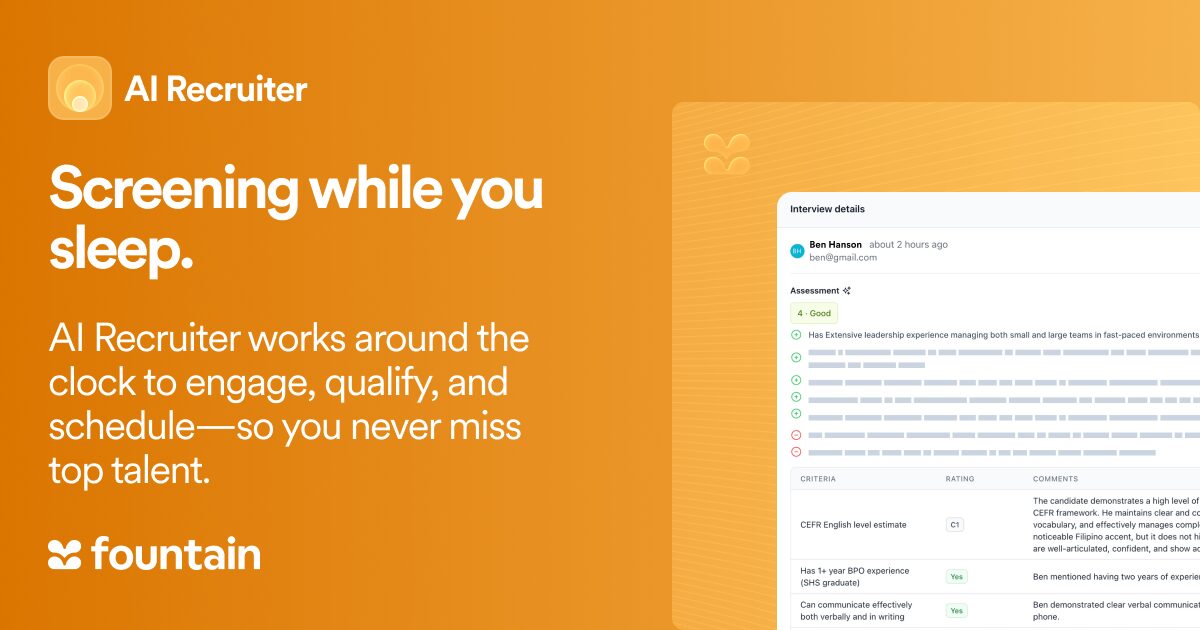
See How Fountain’s AI Recruiter Uses Agentic AI to Cut Screening Time by 79%
Fountain’s AI Recruiter leverages Agentic AI to transform how hiring gets done—screening candidates, scheduling interviews, and surfacing insights automatically. No prompts. No bottlenecks. Just faster, smarter, always-on hiring.
If your team is stretched thin or struggling to keep up with high-volume roles, now’s the time to see what Agentic AI can do.
Interview scorecard Role: ________ | Candidate: ________ | Interviewer: ________ | Date: ________
Competency 1: Oral communication Question: “Describe a time you had difficulty communicating with a customer, what you did, and the outcome.” Score (1–5): 1 = no job-relevant evidence | 3 = a relevant example with adequate detail | 5 = specific actions and strong results. Notes (situation, the candidate’s own actions, result; no evaluative or demographic remarks): ________
Competencies 2 through 5: repeat the block above with one question each.
Total: ____ / 25. Add the scores. Do not adjust the total for overall impression.
4. Brief interviewers and candidates
Assign each panelist competencies to probe so the panel covers all of them without repeating. Give candidates the format, location, expected length, and a clear way to request an accommodation: treat every request as time-sensitive, since a slow response can cost the candidate their chance to compete.
Self-scheduling and reminders handle the logistics: see our guides on scheduling interviews and cutting no-shows.
With criteria, questions, and logistics settled, the interviewer walks in with one job left: collect evidence.
During the interview
In the room, the interviewer collects consistent evidence, and unstructured small talk can distort it. Early interview impressions, formed two to three minutes into rapport-building, predicted both later ratings and offer decisions, so keep rapport brief and identical for every candidate.
Build the scripted opening, questions, and feedback fields into the same ATS workflow so evidence lands in one place.
- Open the same way every time. State the interview length and explain the standardized format and note-taking process. An accessibility-aware welcome means speaking directly to the candidate, including when an interpreter or companion is present, with alternate formats ready.
- Listen more than you talk. Spend most of the conversation probing, and let follow-ups separate the candidate’s own actions from the team’s work and establish the outcome. Under the formal probing rules, ask candidates to clarify “we” statements, narrow in on their own actions, and never lead the answer.
- Score against the rubric, not your gut. Identical questions limit bias, but the interviewer still has to watch for it. Similar-to-me bias favors candidates who resemble you, and in a cultural similarity study of 120 hiring interviews, sociologist Lauren Rivera found employers favored candidates who matched their own leisure pursuits and self-presentation. The halo effect lets one strong or weak answer color every score, so score each competency separately and in order.
- Stay inside the legal lines. This is general information, not legal advice, and requirements vary by state, so have counsel review your question bank against current EEOC (Equal Employment Opportunity Commission) guidance before you use it. Tying every question to a competency in your structured interview, rather than to a candidate’s personal characteristics, is what keeps the conversation both consistent and defensible.
- Present the role honestly, and close with a plan. Let candidates evaluate whether the job’s real expectations fit theirs, then give them a written follow-up: the decision date and a recruiter contact, so the next step is never a mystery.
The candidate leaves with a timeline. The interviewer leaves with notes that still have to become a decision.
After the interview
After each interview, panelists should score independently against predefined benchmarks before debriefing, deciding, and following up on time. Under post-interview guidance, each panel member should review their notes right after the candidate leaves the room and rate before any discussion, so ratings stay specific and defensible.
Configure the ATS so each interviewer submits feedback before the candidate advances, then trigger the status update automatically.
- Score before you compare candidates. Apply the scorecard benchmarks to each response, then add the numbers instead of weighing them by feel. Combining scores mechanically beat expert judgment by more than 50% in predicting job performance, even among people who knew the jobs well.
- Resolve conflicts with evidence, not seniority. Read the behavioral notes in each panelist’s scorecard rather than deferring to the loudest voice or the most senior one. At Microsoft, an independent feedback safeguard blocks a hiring manager from seeing colleagues’ feedback until they submit their own, which keeps one opinion from anchoring the room.
- Follow up inside the window you promised. Candidate interest can fade fast during the interview process, so treat the promised date as the real deadline. A late update reads the same as no update at all.
Independent scoring and timely follow-up turn interview evidence into a defensible decision while keeping candidates informed.
Interview formats in brief
Choose the interview format based on logistics, not on which candidate is applying: the structured method stays constant, and once you pick a format for a role, every candidate for that role gets it. Select one format per role in the ATS, and for high-volume phone screening, pilot agentic voice screening on the same criteria: it runs around the clock, and only qualified applicants reach a human for review.
- In-person fits final-stage interviews and roles where the candidate needs to see the work environment before accepting.
- Video replaces in-person when geography or schedules get in the way; our post on virtual interviews covers setup and testing.
- Phone works as a first-pass filter on knockout criteria before anyone books a longer conversation.
- Panel interviews add raters, which can reduce individual bias and help the group document and interpret the information more completely.
- High-volume hiring leans on same-day events and around-the-clock voice screening; scheduling becomes the constraint, and the guide above covers self-service booking.
Whatever the format, the scorecard and question bank travel with it.
Common interviewing mistakes
The most common interviewing mistakes come from abandoning clear criteria, consistent questions, evidence-based scoring, and timely follow-up. Audit the ATS workflow for inconsistent questions, missing score fields, and delayed messages, then enforce the question bank and automate candidate updates.
- Skipping job analysis leaves scoring to gut feel. Without named competencies, interviewers score whatever impressed them, not what the job needs.
- Generic or trick questions don’t map to any competency. “Tell me about yourself” and brain teasers make for good conversation and bad evidence.
- Talking over listening starves the scorecard, and confidence gets read as competence. An interviewer who dominates the conversation collects less evidence, and a strong handshake or fluent delivery isn’t proof of job performance. Guard against false predictors like appearance and eye contact, and score only what the candidate did in the situation they described.
- Leading or non-job-related questions undo the interview’s fairness. OPM’s probing rules cover the first; tying every question to a competency, and having counsel clear the bank, covers the second.
- Undefined “culture fit” brings back the bias the structure was built to remove. Rivera’s cultural-similarity finding above shows where an ungoverned “vibe check” leads; scorable behaviors, recorded without evaluative or demographic remarks, replace it.
- Slow follow-up costs you the candidate. Interest fades during the interview process, and the promised date is the real deadline.
- Inconsistent interviews produce scores you can’t compare. Different questions for different candidates break the comparison the scorecard exists to enable.
Every fix on this list gets harder as the number of interviewers grows, which is the problem high-volume employers actually have.
How Fountain runs high-volume interviewing
For high-volume interviewing, agentic voice screening and workflow automation carry the repeatable parts of the process, while recruiters and hiring managers keep the hiring decisions. At a location hiring dozens of people a month, the manager running interviews is also running the floor, and structure is the first thing to slip.
Cue is the entry point. A recruiter types a goal in plain language, such as “Hire 10 drivers before Monday,” and Cue turns it into coordinated tasks across the hiring workflow. Anna, Fountain’s AI Recruiter, runs structured voice screening around the clock and surfaces qualified applicants for review, while Emma answers candidate questions between steps, and recruiters and hiring managers still make the advancement call.
In the Agentic AI for Frontline Workforces report, 74% of frontline workers said they would choose an AI interview over waiting for a human one, so always-on screening cuts scheduling friction without moving the decision off a person’s desk. Between steps, the ATS sends automated updates over SMS, email, and WhatsApp, so no candidate is left in silence.
The ATS carries candidates from application through scheduling; once an offer is accepted, Onboarding starts the paperwork and Shift & Scheduling assigns the first shift.
Fetch, a package delivery platform operating in 27 major U.S. markets, saw a 95% decrease in average time-to-hire with Fountain, from 15 days to 6.5 hours. For multi-market employers, integrating screening, scheduling, and follow-up can compress hiring into the same day and shrink the window in which candidates disappear.
A good interview predicts performance and keeps the candidate in the process, and both get easier when the structure is built once, runs the same everywhere, and a person still approves every advancement.
Book a demo to see how we run structured interviewing at your volume.
Frequently asked questions about conducting a job interview
How do you run a structured interview?
A structured interview starts with four to six competencies drawn from the job, one or two questions per competency, and a fixed 1–5 rating scale with labeled anchors. Every candidate hears the same questions in the same order, and each interviewer scores independently before the panel discusses.
How do you keep interview questions compliant?
Tie every question to a competency in your structured interview, not to a candidate’s personal characteristics: that same discipline is what keeps a question bank defensible under ADA (Americans with Disabilities Act), GINA (the Genetic Information Nondiscrimination Act), and Title VII guidance. Have counsel review your full question bank, plus any criminal-history or salary-history questions, against the rules in every jurisdiction where you hire.
How long should a job interview be?
A practical benchmark is 45 to 50 minutes for a structured interview, including time for behavioral questions, the candidate’s questions, and scoring afterward. Shorter first-pass screens can focus on knockout criteria before anyone books a longer conversation.