A single compliant background check is easy to track manually. At hundreds of checks a month across dozens of locations, manual work stalls offers and creates compliance errors: missed disclosures, late adverse action letters, and decisions that vary by location. Background checks and compliance rank as a top hiring bottleneck for 36% of organizations, per Aptitude Research’s February 2026 Frontline Hiring Reckoning.
The same six steps apply to one hire or 500. At scale, automated ordering, consistent routing, and audit controls keep them consistent across locations. This is general information, not legal advice; employers running checks at volume should have counsel review the policy before it goes live.
What is an employee background check?
An employee background check verifies parts of a candidate’s identity and history through a consumer reporting agency (CRA). Depending on the role, a consumer report may cover criminal records, employment and education history, driving records, and credit history where lawful and relevant.
The check mix should follow role-specific relevance, so a delivery driver gets a motor vehicle record (MVR) check while a cash-handling associate is screened for theft-related convictions. Background checks are one part of a broader screening category that also includes drug testing and reference checks, covered in our pre-employment screening guide.
Step 1: write the background check policy first
The policy comes before the provider. A written policy can become key defense evidence in a lawsuit charging you with discrimination, and it’s the only thing that keeps dozens of recruiters across hundreds of locations from making different calls on the same record. The policy defines which checks run for each role tier, which findings disqualify, and which findings route to human review.
Store the approved role-by-location policy in your ATS so every recruiter applies the same adjudication matrix. The policy should also specify when recruiters may ask about criminal history, which varies by jurisdiction.
An example keeps the check package and reviewer consistent for each role:
| Role type | Example check package | Who reviews a hit |
| Delivery driver | Identity, criminal history, motor vehicle record | Trained reviewer, individualized assessment |
| Cash-handling associate | Identity, criminal history (theft-relevant) | Trained reviewer, individualized assessment |
| Roles serving vulnerable people | Identity, criminal history (violence-relevant) | Trained reviewer, individualized assessment |
The policy should also specify when recruiters may ask about criminal history, which varies by jurisdiction. Counsel reviews it once; recruiters then execute it thousands of times without improvising.
Step 2: choose an FCRA-compliant provider that plugs into your hiring workflow
The Fair Credit Reporting Act (FCRA) governs any employment check run through a CRA, so the provider’s compliance tooling matters as much as its search coverage. Disclosure templates and adverse action workflows belong on the evaluation list alongside multi-state coverage and a real applicant tracking system (ATS) integration, so checks order and return inside the hiring funnel instead of a separate portal.
That integration is what holds up at volume. When ordering happens inside the funnel, nothing waits on a recruiter opening a second system, and the check starts the moment the stage changes.
Deeper vendor-selection criteria live in the pre-employment screening guide; for high-volume employers, the test is whether checks order and results return without leaving the funnel.
Step 3: deliver the standalone disclosure and collect written consent
The FCRA requires a clear and conspicuous disclosure “in a document that consists solely of the disclosure,” plus written authorization before anything is ordered. The disclosure can’t sit inside the employment application. The authorization may share that document, but everything else is excluded: “nothing else is permitted by the FCRA.”
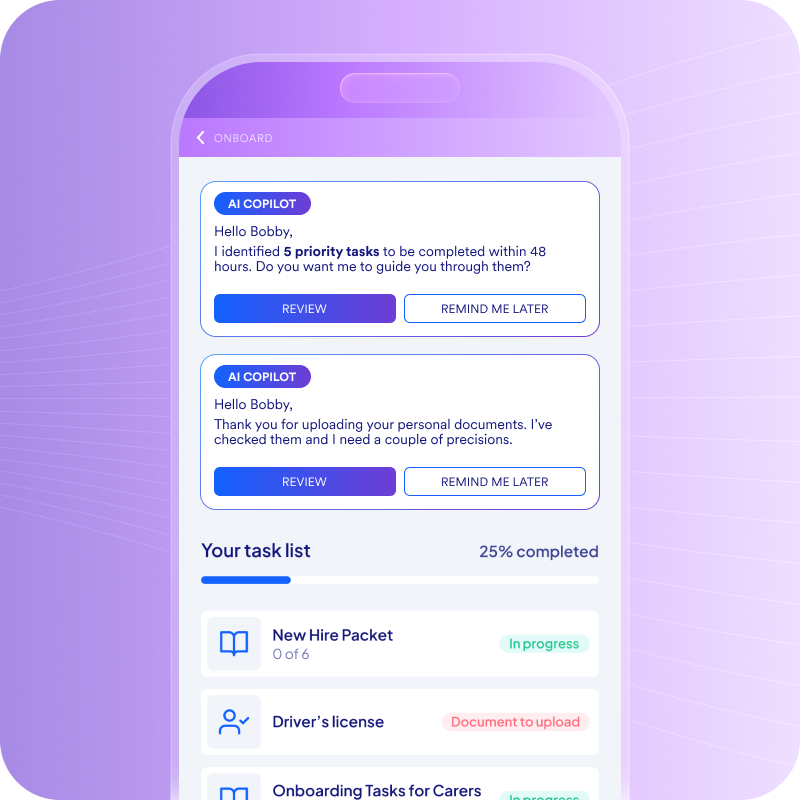
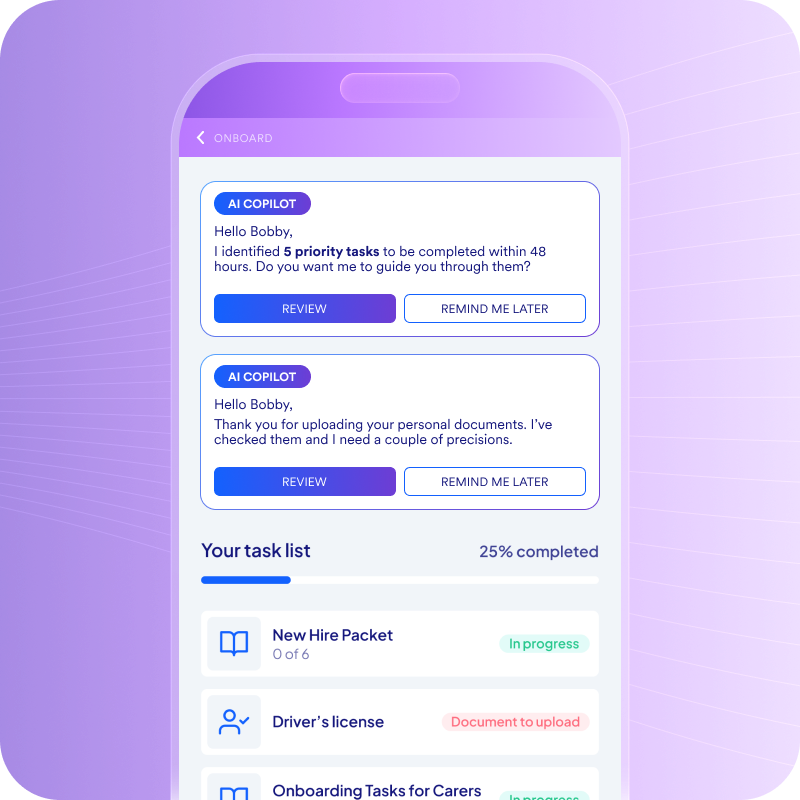
Faster ramp-up. Lower early attrition. AI onboarding built for speed, scale, and retention.
Top employers are already using Fountain’s Frontline OS to:
✅ Reduce turnover in the first 60 days
✅ Eliminate manual paperwork and task delays
✅ Accelerate new hire productivity with smarter workflows
Curious what smarter onboarding could unlock for your team?
Liability waivers, extra acknowledgements, even bundled state notices all violate the standalone rule. In Gilberg v. California Check Cashing Stores, the Ninth Circuit held that folding state disclosure requirements into the same document is itself a violation and refused implied exceptions to it.
Because candidates may authorize from their phones, capture the disclosure and authorization as a mobile stage in your ATS, timestamped to the candidate file. A candidate who has to find a printer delays authorization, and the check waits with them.
Step 4: trigger the check at the conditional-offer stage
Conditional offer first, then the check. Several jurisdictions require that order, and in a Professional Background Screening Association survey, 66.3% of employers already run checks after a conditional offer. California fair-chance rules and New York City rules prohibit criminal history inquiries before a conditional offer, and Washington’s amended law extends the same requirement to employers with 15 or more employees as of July 1, 2026.
Align check timing to the strictest local rule that applies to each hire and to your policy, and confirm it with counsel.
At high volume, the check should fire automatically on that stage change, not on a recruiter remembering to log into a portal that afternoon. Every manual trigger is where one location’s checks go out immediately and another’s wait for someone to remember.
Step 5: review results consistently, with a human on every hit
Blanket disqualifications are a Title VII risk. The Equal Employment Opportunity Commission (EEOC) enforcement guidance calls for an individualized assessment weighing the nature and gravity of the offense, the time that has passed, and the nature of the job, plus a chance for the candidate to add context like work history since the offense or rehabilitation.
Applied uniformly, criminal-record exclusions can disproportionately screen out candidates of a particular race or national origin, and an exclusion the employer can’t show is job-related and consistent with business necessity is unlawful under a disparate-impact analysis.
In 2015, BMW paid $1.6 million to settle EEOC allegations that its conviction guidelines excluded African-American logistics workers at a disproportionate rate. Route every criminal-record hit to a trained reviewer for that assessment.
The individualized assessment is human judgment, but judgment applied against your Step 1 policy. When every hit routes to a trained reviewer using the same adjudication matrix, identical records produce identical outcomes across locations.
Same record. Same review. Every location.
Step 6: run adverse action, and disputes, by the book
Skipping or rushing adverse action can create class-action exposure. A pre-adverse action notice goes out first, with a full copy of the report and the Consumer Financial Protection Bureau’s (CFPB) “Summary of Your Rights Under the Fair Credit Reporting Act.”
A real waiting period follows. There is no federal minimum; a 5-day period may be reasonable, though the circumstances, and some jurisdictions, can require longer. Under California rules, the 5 days run from the candidate’s receipt of the letter. The final notice then names the CRA and its contact information, states that the CRA did not make the decision, and tells the candidate they can get a free copy of the report within 60 days.
If a candidate disputes the report, coordinate with counsel and the CRA before taking final action. The CRA reinvestigation period is 30 days, extendable to 45 when the consumer supplies more information, and a decision shouldn’t be finalized while material information stays in dispute.
Configure the workflow to hold the final notice until the waiting period ends and to pause final action while a dispute remains open.
Where background checks stall at scale, and what to watch
At hundreds of hires a month, background checks stall in four predictable places: manual ordering, portal-hopping, per-location policy drift, and the courthouse long tail.
- Manual ordering: Checks initiated by hand fire whenever a recruiter gets to them, so a search goes out within the hour at one location and sits until someone remembers at another.
- Portal-hopping between the ATS and the CRA: Results returning outside the funnel mean recruiters re-key data, statuses drift out of sync, and nobody owns the candidate while the check runs.
- Per-location policy drift: When recruiters reuse one region’s process in another, they can violate local disclosure or timing rules without knowing it.
- The courthouse long tail: Court-access differences create unusually long delays when a search lands in a manual jurisdiction.
Four signals tell you whether the system is holding. Turnaround time by check type comes first, because a blended average hides the county long tail. Dispute rate surfaces recurring report-accuracy problems.
Comparing check duration with candidate drop-off at the check stage shows whether longer waits are costing you candidates. And audit readiness, tracked through a regular HR compliance audit, is the share of hires whose consent form and adverse action letters can be produced on demand.
How Fountain runs background checks inside the hiring workflow
We run the hiring workflow around each background check; the CRA runs the search itself. Cue, the orchestration layer inside every Fountain product, turns written instructions into recurring tasks: ordering checks, flagging delays, and routing records for review.
A program owner can write, “order background checks for everyone who cleared interviews this week, flag anything stalled past 3 days, and route hits to the hiring manager for review.” Ordering and routing that used to depend on someone’s memory become standing instructions, stall detection included, with a manager still approving every exception.
The agents Cue coordinates are all live today. While a check runs, candidates can go dark, and status questions land on recruiters who don’t yet have an answer.
Emma, Fountain’s I-9 and W-4 consultant, answers candidate paperwork and status questions around the clock so those days don’t cost you the hire. Anna handles voice screening upstream so candidates reach the conditional-offer stage faster, and Sam tracks post-hire engagement once they start.
Underneath, the ATS captures the standalone disclosure and written consent as a workflow stage, timestamped to the candidate record, and its audit logs preserve the adverse action trail regulators and plaintiffs’ attorneys ask for first.
The Integration Center integrates with major background-check providers, including Checkr, HireRight, First Advantage, and Certn, so checks order on the stage change and results return to the same record instead of a separate portal. After the check clears, Onboarding handles I-9 completion and E-Verify, a separate compliance track that sits next to screening rather than inside it.
A signed disclosure that lives only in a CRA portal is the one document you can’t produce fast when a plaintiff’s attorney asks; if it isn’t retrievable, it isn’t audit-ready.
Stitch Fix moved warehouse hiring onto Fountain’s ATS and raised the percentage of applicants who pass background checks and show up on day one from 68% to 95%, a 40% increase. The six steps govern every background check; at 500 a month across 50 locations, the difference is a workflow that triggers each one automatically and preserves a record staff can retrieve a year later.
If checks are where your funnel stalls, book a demo and watch Cue trigger checks on the stage change, Emma field candidate status questions, and the audit trail assemble itself.
Frequently asked questions about employee background checks
Can you run background checks on current employees?
Yes, and the FCRA applies the same way it does pre-hire. You owe a standalone disclosure, written authorization, and the full adverse action process before taking any negative employment action based on the report. A rescreening policy should also name which roles get rechecked and on what schedule, so post-hire checks are as consistent as pre-hire ones. Continuing consent isn’t recognized in every state, and in California a new consent form may be required for each search.
What shows up on a background check, and how far back does it go?
Under federal reporting limits, non-conviction adverse items like arrests and civil judgments are generally limited to 7 years for positions paying under $75,000, while criminal convictions carry no federal time limit. State laws may also cap conviction reporting at 7 years; New York has a $25,000 threshold, so what a report contains depends on where the candidate lives and works.
How long does an employee background check take?
Database searches can return quickly, while county criminal searches, verifications, and drug screens often take longer and vary widely. The slowest component sets the total, and checks touching manual courthouse jurisdictions can run well past the average.
How much does one background check cost?
Cost depends on the package and the counties involved, with basic criminal packages at the low end and fuller packages adding county searches, verifications, and drug screens at higher tiers. When comparing costs, ask whether court, motor vehicle department, and database passthrough fees bill separately and how they affect per-hire cost.
Can someone start work before the background check clears?
Sometimes, though not for every role, and it depends on the role and applicable law. For roles where a contingent start is legally permissible, shortening turnaround avoids putting workers on the job before their checks clear, and our pre-employment screening guide covers which checks apply where.
Do all roles need the same checks?
No; checks should match role risk, such as requiring MVRs for driving roles. Cash-handling roles make theft-related convictions job-relevant, and for roles serving vulnerable populations, violent-crime history is relevant. Role-based screening keeps costs down and keeps each check defensible.