
Hiring delivery drivers means moving fast enough to cover routes without skipping the license, record, and insurance checks that keep drivers and customers safe. The Bureau of Labor Statistics projects about 152,700 openings a year for delivery truck drivers and driver/sales workers through 2035.
Growth accounts for only about 103,000 jobs across that decade. The rest are replacements, so employers need a pipeline that runs continuously, not a one-time push. Many of those replacements follow early exits. In the 2025 Fountain Frontline Report, 43% of frontline new hires left within 90 days, at roughly $7,000 per replacement. A driver who quits in week six wastes the recruiting spend and leaves a route uncovered.
The six steps below show how to build a safer, faster frontline hiring funnel for drivers: how to sequence the work, keep candidates informed, and automate the routine steps so your team’s time goes to judgment calls.
Step 1: Define the role and write a posting that filters for fit
“Delivery driver” covers at least four jobs. Restaurant, last-mile parcel, grocery, and box-truck drivers work with different vehicles, insurance arrangements, and physical demands. Before posting, settle which one you’re hiring, who supplies the vehicle, and how routes get assigned.
Licensing is where postings most often go wrong. The vehicle, not the job title, determines which license a role needs, so confirm the requirement for each vehicle in your fleet with your safety or compliance lead, then state it plainly in the posting. An unclear license line either scares off qualified drivers or fills the funnel with people who can’t take the route.
Put pay, schedule, vehicle, and physical demands in the first few lines. A posting that fits on one phone screen looks like this:
Delivery Driver, [City] Hub. $[X] to $[Y] per hour, paid weekly. Four 10-hour shifts per week, posted 14 days ahead. Routes assigned by dispatch each morning, with about [N] stops. Company cargo van; a standard driver’s license is required (no CDL). Clean motor vehicle record for the past three years. Repeated lifting of packages up to [X] lbs, with or without reasonable accommodation. Apply from your phone in under five minutes.
Every line answers a question candidates would otherwise ask after applying, so applicants already know the job fits.
Step 2: Source drivers beyond the job boards
Volume alone doesn’t keep routes covered. These four channels let you source candidates without job board fees:
- Put text-to-apply listings where drivers already are. A text keyword on a hub flyer or a QR code on a van reaches people who already drive past.
- Ask current drivers for referrals, and pay for the outcome. Referred workers in trucking, call centers, and tech were less likely to quit, and referred truckers had fewer accidents. Paying the bonus after day 60 or 90 ties the incentive to retention.
- Re-engage past applicants and former drivers. Candidates who cleared screening last peak and drivers who left over a schedule conflict already have license data on file, so a text before the holiday ramp costs nothing.
- Recruit from adjacent pools. BLS data shows 39% of driver/sales workers work in food services and 17% of light truck drivers work in retail, so warehouse, retail, and app-based delivery workers already know the pace.
Tag every applicant by source, then compare retention at 30, 60, and 90 days by channel. A channel that yields 200 applicants and four drivers still on the road at day 90 is losing to one that yields 30 applicants and nine.
Step 3: Screen quickly without skipping safety checks
A fast driver funnel comes from sequencing, not from cutting steps. Knockout questions fire the moment the application is submitted, long-lead checks start at the stage your team sets for them, and the interview and any road test follow within a day or two. Which checks a role needs, and in what order, varies by role, vehicle, and location, so have your safety and compliance team define the stages and their order.
The operational job is building a workflow that runs them the same way every time.
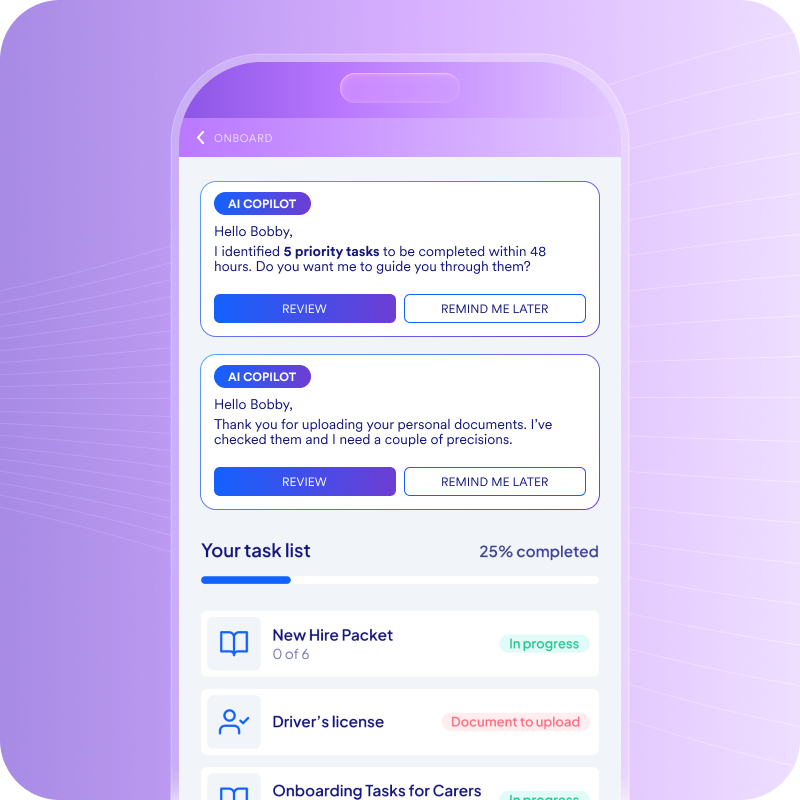
Faster ramp-up. Lower early attrition. AI onboarding built for speed, scale, and retention.
Top employers are already using Fountain to:
✅ Reduce turnover in the first 60 days
✅ Eliminate manual paperwork and task delays
✅ Accelerate new hire productivity with smarter workflows
Curious what smarter onboarding could unlock for your team?
Automate the yes/no questions your team has already defined: license type, minimum age for the role, shift availability, and vehicle ownership when the role needs one. Whether a three-year-old speeding ticket matters stays a human judgment call.
Once your team has defined the stages, four moves keep screening fast and consistent:
- Start long-lead checks at the earliest stage your team has approved for them. Motor vehicle record (MVR) requests and other checks that take days to return can then run while the interview is being scheduled, so results are often back before the hiring decision.
- Give every required check its own stage. Background checks, drug testing where it applies, and insurance verification for drivers who supply their own vehicle each get a stage in the order your compliance team defined, so no one has to remember it. Personal auto policies generally exclude commercial use such as deliveries, which is why the insurance stage matters for owner-operated roles.
- Put consent forms and disclosures on the candidate’s phone. Whatever authorizations your process requires, candidates should be able to review and sign them in the same mobile flow they applied in, instead of waiting for an email or a visit to the hub.
- Keep candidates informed while results are pending. A text at every stage change (“Your background check is in progress; we’ll text you within two business days”) and self-booked interviews stop qualified drivers from drifting to a competitor.
Mapped this way, each check runs at the stage your team defined, which keeps pre-employment screening fast and consistent, and a person reviews every exception and makes every decision not to hire.
Step 4: Interview for judgment, not just experience
Scenario questions show how a driver handles the road better than résumé questions. Structured interviews, with the same questions and scoring guide for every candidate, are among the better-validated selection tools.
Six scenarios to start with:
- Late delivery: “You’re 40 minutes behind with 15 stops left and dispatch hasn’t called. What do you do first?” Listen for proactive communication.
- Upset customer: “A customer is angry that yesterday’s package was left in the rain. How does that conversation go?” This shows composure and ownership.
- Minor accident: “You clip a mirror backing out of a loading dock. Nobody is hurt. Walk me through the next 10 minutes.” This tests whether reporting is reflexive.
- Damaged package: “A customer says the box is damaged, but you can’t see any damage. What do you say and record?” The answer reveals documentation habits.
- Unfamiliar route: “Your GPS drops and the address is a rural box number. What do you do?” Strong candidates call dispatch.
- Unsafe behavior: “You see a teammate texting behind the wheel. What do you do?” This tests willingness to speak up.
Have each interviewer score independently before comparing notes. Add a road test for unfamiliar vehicle types or borderline MVRs, and a supervisor ride-along on the first route for lighter vans.
Step 5: Close the gap between offer and first route
Accepted candidates can vanish before the first route. In 2025, 41% of organizations told SHRM candidates were ghosting them during interviews, and in high-volume hourly roles some accept an offer and disappear before their start date.
Send the written offer to the candidate’s phone the same day as the interview, with pay, vehicle costs, shift pattern, and Day 1 spelled out. A confirmation text two days before the start catches no-shows while you can still call the next candidate.
Then use the days before the first solo route, because onboarding speed shapes retention, not just start dates. Move onboarding paperwork online so new hires finish forms before Day 1 instead of on it. Vehicle and app training should be specific to the vehicle the driver will operate, incident reporting gets taught before the first incident, and a week of short routes beside a veteran driver finishes the handoff.
GoFor, a last-mile delivery company, cut its time-to-onboard by 83% with Fountain, from about 30 days to 5, and reduced applicant attrition by 62%.
Step 6: Retain drivers past the first 90 days
Retention past 90 days depends on five working conditions, not perks:
- Make the vehicle math part of the pay. If drivers use their own cars, use a clear reimbursement rate, document it, and state it in the posting and the offer. Some employers use the IRS business mileage rate (72.5 cents per mile for 2026) as an optional benchmark.
- Post schedules and routes in advance. Hourly service workers with unstable schedules are more likely to quit, so two weeks’ notice is a sensible floor for drivers.
- Assign routes fairly and set realistic workloads. Rotate heavy routes and base stop counts on last quarter’s actual completions.
- Keep vehicles and devices reliable, with a fast fix path. A van in the shop or a dead scanner is a lost day of pay, so drivers should know who to text and how long the fix takes.
- Check in early and show a path forward. Manager conversations at days 7, 30, and 60, plus a visible track to lead driver, trainer, or dispatcher, give drivers a reason to stay.
Track 30-, 60-, and 90-day retention by source and location. When two hubs with identical pay diverge, the gap usually traces to a manager or route design you can fix.
Where Fountain fits
Most delivery employers run this funnel across half a dozen tools, and every handoff adds lag that loses drivers. Fountain is the platform. Cue, Fountain’s Frontline Superintelligence, is the intelligence.
A hub manager asks Cue to “Hire 10 drivers for the Dallas hub before Monday,” and the funnel above starts moving:
- Cue proposes a plan, the manager approves it, and Cue runs the work across Fountain’s five products, starting with Source and CRM to reach new applicants and past ones.
- Anna, the AI Recruiter, interviews applicants 24/7 over voice and chat, scores each on the same rubric, and writes results into the ATS.
- The ATS runs each check your team requires as its own stage, with background checks through partner integrations such as Checkr, Yardstik, HireRight, and Certn, and managers sign off on every offer.
- Emma, AI 24/7 Support, answers candidate questions over web, SMS, and WhatsApp and clears paperwork blockers in Onboarding, while Shift & Scheduling gets routes posted early.
Fetch, a last-mile delivery company handling 10,000+ monthly applicants with three recruiters, saw a 95% decrease in average time-to-hire (with Fountain AI), with its Yardstik integration clearing applicants in as little as one day. Speed and safety, in one funnel.
Staffing routes this quarter? Book a demo to see one request to Cue, Anna’s scoring rubric, and each screening stage running in the order your team sets on a live driver workflow.
Frequently asked questions about hiring delivery drivers
Do delivery drivers need a CDL?
It depends on the vehicle, not the job title. Most roles that use cars, minivans, or standard cargo vans need only a regular driver’s license, while larger trucks can require a CDL and extra qualification steps. Confirm the requirement for each vehicle in your fleet with your safety or compliance team, then put it in the posting so candidates can self-select.
How long does it take to hire a delivery driver?
It depends on the checks more than the interview. Each check returns on its own schedule, so build your timeline around the stages your team has defined and keep candidates updated while results are pending.
Should delivery drivers use their own vehicles?
It depends on which costs you want to carry. Personal vehicles lower fleet capital but bring reimbursement costs and insurance gaps. Company vehicles cost more up front but close those gaps.