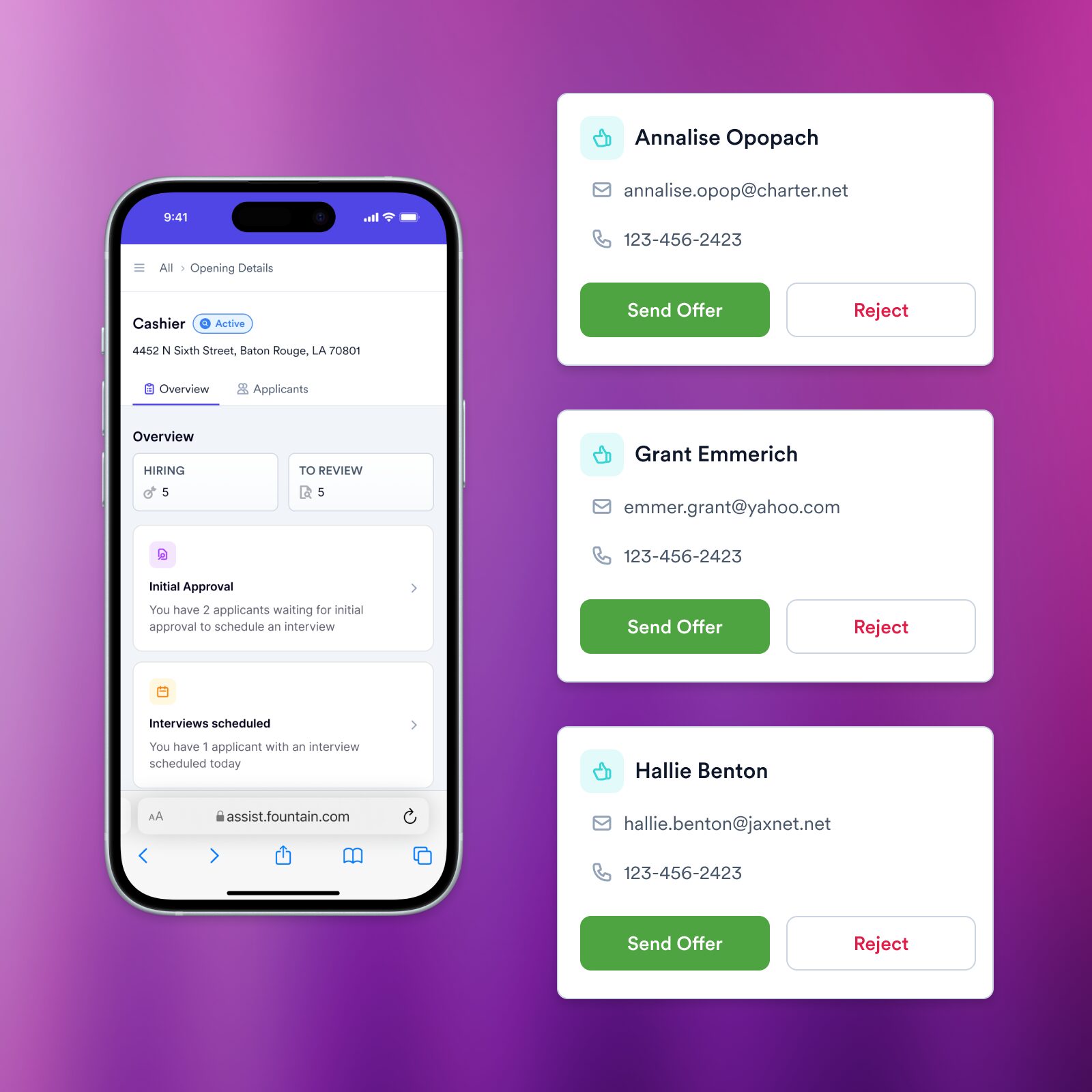
Frontline hiring teams face a problem corporate recruiters rarely encounter: thousands of open roles, candidates applying from their phones between shifts, and a hiring window measured in hours. Aptitude Research reports only 25% of talent acquisition (TA) leaders rate their technology as very effective in high-volume hiring, while 82% are increasing investment. Per Fountain’s Redefining Frontline Operations research, 60% of applicants abandon applications that feel too long or aren’t mobile-optimized.
Software is becoming the back end; agents are becoming the front end. The 2026 evaluation question is whether the tool’s agentic AI can screen candidates, schedule interviews, and run onboarding without a human in the loop. Dashboards no longer differentiate.
What is a sourcing tool for frontline hiring?
A sourcing tool for frontline hiring finds, attracts, and engages hourly candidates inside a mobile-first flow that runs from first job-ad impression through first shift, often within a day. Volume reaches millions of applicants per quarter at the largest employers, the experience is almost entirely on a phone, and the first credible offer usually wins.
How to evaluate sourcing tools for frontline hiring
Five criteria separate frontline-grade tools from corporate ones, with the agent layer carrying the heaviest weight.
- Weigh agent depth ahead of every other criterion. Look for named agents that screen, answer questions 24/7, and run post-hire engagement, plus an orchestrator that coordinates them. Most tools have one agent at most.
- Test the mobile-first apply flow on a real mid-range Android phone. Confirm the candidate completes the application end-to-end without leaving SMS or WhatsApp.
- Measure speed from source to offer in days, not weeks. Demand proof points showing real reductions, not vendor claims of “faster hiring.”
- Require AI-assisted screening with a human manager approving every hire. Full automation creates legal and quality risk; the right pattern keeps the agent on volume and the human on the offer call.
- Verify native HRIS and payroll integration plus built-in talent pool reactivation. Dead-ending at the offer letter creates manual entry for every hire, and re-engaging past applicants costs a fraction of sourcing new ones.
Tools that clear the platform criteria but ship shallow agents appear lower with that gap called out.
| Platform | Category | Agentic AI architecture | Mobile-first apply | Native scheduling | HRIS integrations | Best for |
| Fountain | Frontline hiring platform | Orchestrator + voice-screening, candidate-support, post-hire agents | Yes | Yes | ADP, UKG, SAP, Workday native | High-volume QSR, retail, logistics, staffing |
| Paradox (Workday) | Conversational AI | Olivia (SMS/chat agent) | Yes (SMS/chat) | No | Workday native; ADP | Workday customers at frontline volume |
| iCIMS | Enterprise ATS | Frontline AI module (via Apli) | Yes | No | Broad partner ecosystem | Enterprises needing one ATS for corporate + frontline |
| SmartRecruiters (SAP) | Enterprise ATS | AI-assisted matching, no named agent | Yes | No | SAP native | SAP SuccessFactors customers |
| Workstream | Frontline ATS | Rules-based screening; tier-gated “VoiceAI” | Yes | No | ADP Workforce Now; partners | Franchise and QSR on major HRIS |
| Harri | Hospitality WFM | Carri (chat/scheduling) | Yes | Yes (native) | Paylocity | Restaurant and hospitality hiring + scheduling |
| Appcast | Programmatic job ads | None (sourcing layer) | N/A | N/A | Major ATS platforms | TA teams managing job-ad spend |
| Indeed | Job board + sourcing | Talent Scout AI (shortlist agent) | Yes | No | 350+ ATS integrations | Broad reach across role types |
| ZipRecruiter | Job distribution + matching | AI matching, no named agent | Yes | No | ATS integration (Pro only) | SMBs wanting multi-board distribution |
The profiles below explain why each platform earned its row.
What are the Best Sourcing Tools for Recruiters?
1. Fountain
Fountain is the AI-native platform purpose-built for the global frontline workforce, hiring 1.2 million workers annually across 78 countries. Customers span logistics, retail, QSR, and outsourced services. The differentiator is the agentic layer above the platform.
Proof points:
- Bojangles (750-location QSR chain) cut time-to-hire from 30 days to 5.8 days (80% reduction) and dropped job-board spend by 86%.
- Fetch reduced time-to-hire by 95% (15 days to 6.5 hours) with AI voice screening.
- Liveops runs a 44,000:1 applicant-to-recruiter ratio with a 100% fill rate.
Cons: HRIS integration depth varies by setup.
Best for: High-volume frontline employers across QSR, retail, logistics, and staffing who want coordinated agents doing the operational work.
2. Paradox (Olivia / Workday)
Paradox built its position around Olivia, a conversational agent for SMS, web chat, and WhatsApp. Workday acquired Paradox in late 2025, and the conversational ATS became available through Workday Recruiting in early 2026. The product is one text-based agent, not an orchestrated stack: no voice screening, no paperwork-completion agent, no post-hire pulse. A verified reviewer flags the UI as “very mobile-focused,” creating desktop friction.
Best for: Workday customers wanting a single conversational agent for frontline hiring.
3. iCIMS
iCIMS is a long-running enterprise ATS that entered the frontline category via the 2025 Apli acquisition. The resulting Frontline AI module launched in spring 2026 on top of the core ATS. The 800-plus partner ecosystem is the broadest profiled here. A verified Gartner Peer Insights reviewer flags an ATS-CRM gap: “The biggest issue is that the ATS does not talk to the CRM, therefore creates more of a workload on the team.” Frontline maturity is still developing.
Best for: Large enterprises that need one ATS spanning corporate and frontline hiring and can absorb the maturity gap.
4. SmartRecruiters (SAP SuccessFactors)
SmartRecruiters is an enterprise recruiting platform with AI-assisted matching, now inside SAP after SAP’s acquisition closed in September 2025. AI here is assistive features, not named agents acting on outcomes, with no orchestrator. No public integration roadmap has been released, so non-SAP customers face product-continuity uncertainty.
Best for: Organizations on SAP SuccessFactors consolidating recruiting into the HCM stack.
5. Workstream
Workstream is a text-first hiring platform for franchise and QSR operators with the lightest agent layer of the dedicated frontline tools. SMS drives candidate communication; screening is rules-based; “VoiceAI” is gated to higher tiers with no branded agent. HRIS is native to ADP Workforce Now, with Paylocity, Paycor, and Paycom via partners such as Flexspring. No post-hire engagement, no orchestrator.
Best for: Franchise and QSR operators on ADP Workforce Now wanting a simple text-first hiring tool.
6. Harri
Harri is a hospitality workforce management platform bundling hiring, onboarding, and scheduling. SHRM identifies Harri as a “New York City-based employment management platform for the hospitality industry.” Carri is the chat layer for candidates and scheduling, more an interface than an orchestrator. Native scheduling is a real advantage, though a verified reviewer notes the Workforce Management module “just doesn’t work as it should,” and the hospitality-first design limits fit for QSR-at-scale, logistics, or retail.
Best for: Restaurant and hospitality operators who want hiring and scheduling in one platform.
7. Appcast
Appcast sits upstream of the ATS platforms above as a programmatic job-ad layer, not an agent platform. Cost-per-applicant bidding allocates budget across publishers in real time. Without clean ATS integration returning hire-level data, allocation defaults to click metrics rather than quality signals.
Best for: TA teams at frontline employers who already have an ATS and want to compress sourcing spend across publishers.
8. Indeed Hiring Platform
Indeed is the largest job site by traffic, with Talent Scout as its AI shortlist agent on top of 350-plus ATS integrations and 360 million sourceable profiles. The 2025 Appcast report shows cost-per-click rose 27% in 2024, and a March 2026 policy change altered how single-source XML/API feeds appear unless routed through Indeed Apply. Recruiters often report unqualified applicant volume requiring downstream screening.
Best for: Frontline employers needing broad candidate reach who already have an ATS managing the post-application workflow.
9. ZipRecruiter
ZipRecruiter distributes postings to 100-plus partner job boards and uses AI matching to invite candidates. ATS integration is Pro-tier only, and AI here is matching, not a named agent that screens, schedules, or follows up. For the smallest operations, Fountain’s list of free candidate sourcing tools covers the no-cost ground.
Best for: SMBs wanting multi-board distribution with AI matching and no full ATS yet.
How Fountain runs frontline sourcing
Fountain delivers Frontline Superintelligence, a coordinated AI execution layer for the global frontline workforce. At the top sits Cue, which accepts plain-English hiring goals and routes work across sourcing, screening, onboarding, and scheduling.
Under Cue sit three named agents. Anna conducts real voice interviews 24/7, with documented time-to-fill reductions from 17 to 10 days at CLEAR and 55 hours of recruiter time saved at Marsden Services. Emma walks workers through I-9, W-4, and onboarding paperwork on SMS, voice, and web chat. Sam runs Day 1, Day 10, and Day 30 pulse checks, flagging retention risks before workers quit.
The agents operate on a mobile-first ATS (85% mobile apply), Onboarding with E-Verify and OCR, native Shift & Scheduling, a CRM with AI matching, and integrations with UKG, SAP, ADP, and Workday. The friction the opening stats describe (a quarter of TA leaders confident in their stack, six in ten candidates abandoning slow applications) is solved by agents running the operational work and an orchestrator coordinating their effort.
Ready to see frontline sourcing run by agents? Book a demo to watch Cue translate a hiring goal into coordinated tasks, Anna screen real candidates by voice, and Sam catch retention risks before Day 30.
Frequently asked questions about sourcing tools for frontline hiring
What is a sourcing tool in recruiting?
A sourcing tool helps recruiters find, attract, and engage candidates before they enter the formal application process. In frontline hiring, options range from programmatic job-ad platforms like Appcast to full hiring platforms like Fountain that combine sourcing with screening, onboarding, scheduling, and post-hire engagement under a single orchestration layer.
How is programmatic job advertising different from posting on a job board?
A job board like Indeed or ZipRecruiter displays your listing to candidates who search for it. Programmatic advertising (Appcast) distributes your budget across multiple publishers and adjusts bids in real time based on which sources deliver qualified applicants at the lowest cost.
What’s the difference between a sourcing tool and an agentic hiring platform?
A traditional sourcing tool generates candidate volume and hands the candidates to an ATS for the rest of the process. An agentic hiring platform like Fountain runs the work end-to-end: agents screen, schedule, answer questions, run paperwork, and check in post-hire, all coordinated by an orchestration layer. The distinction matters most where manual recruiter touchpoints don’t scale.